
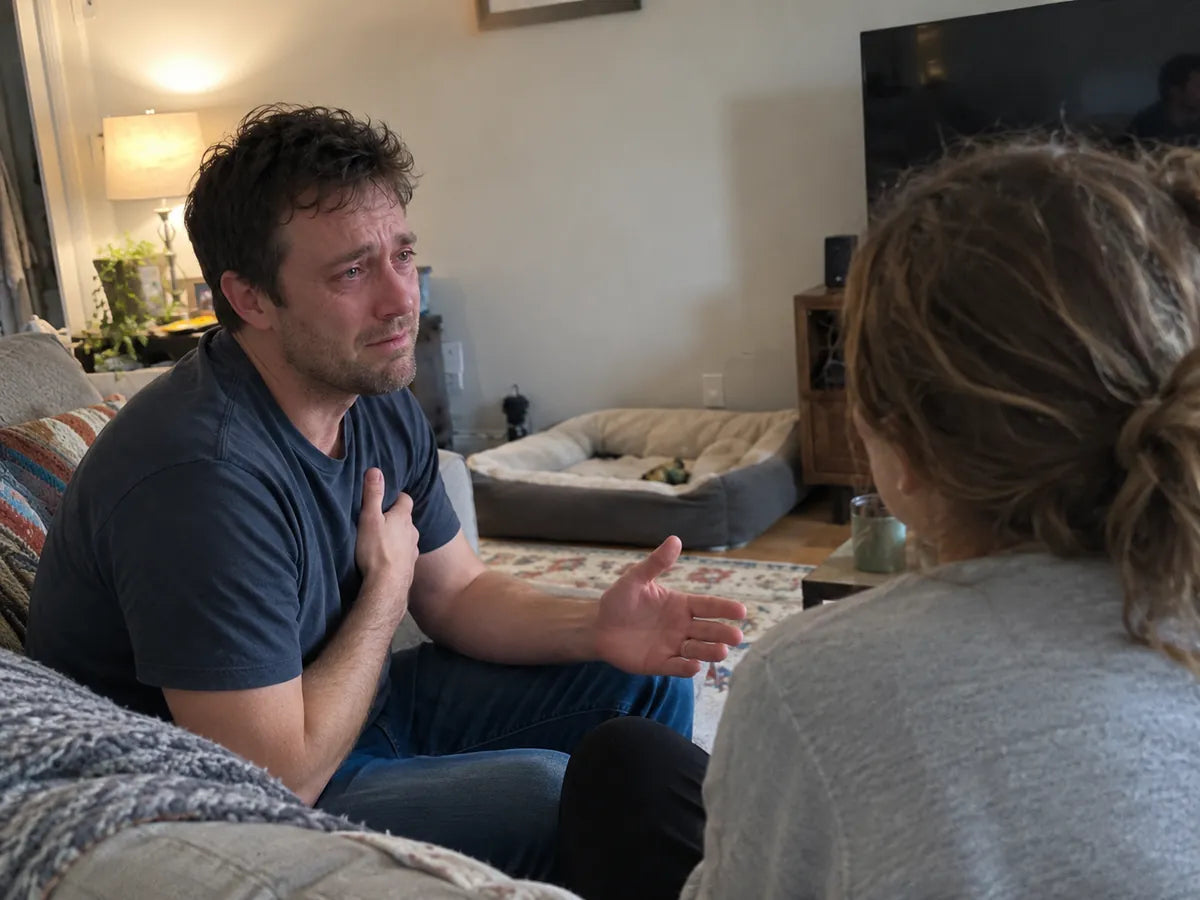
To tell your partner you feel hurt without blaming them, describe the specific thing that happened, name the feeling it brought up, and say what you need going forward. Leave out guesses about why they did it. That combination is honest about your pain while giving your partner room to listen instead of defend.
Why blame makes it harder to be heard
When you're hurt, blame comes out fast. “You humiliated me.” “You don't care about my feelings.” These might feel true in the moment. The problem is what happens next: your partner hears an attack on who they are, and their energy goes into defending themselves. The hurt you wanted them to understand gets lost in the argument about whether they're a bad person.
Saying it without blame is not about being polite or letting them off the hook. It's about getting to the part where they actually hear you.
The three-part structure
- What happened. A specific moment, described the way a camera would see it.
- How you felt. One or two real feeling words.
- What you need. A clear, doable request.
“When you checked your phone during dinner with my parents, I felt embarrassed and a bit alone. Next time, could we keep phones away while we're with family?”
That's it. No backstory, no list of other times, no theory about why they did it.
Part 1: Describe the moment, not the person
Compare these two:
Instead of: “You're so dismissive.” Try: “When I told you about the promotion and you said ‘cool’ and went back to the game…”
The first is a label. It invites “No I'm not!” The second is a moment. Your partner can picture it and is much less likely to argue about whether it happened.
A good test: could a neutral person who was in the room agree this happened? If yes, you've described behavior. If it contains “always,” “never” or a word about their personality, it's drifted into a verdict.
Part 2: Use real feeling words
This is where a lot of well-meant “I statements” go wrong. “I feel like you don't respect me” starts with “I feel,” but it's really a statement about them. Real feeling words describe what's happening inside you.
Some useful ones:
- Hurt, sad, lonely, left out
- Embarrassed, exposed, small
- Worried, anxious, unsettled
- Disappointed, let down
- Overwhelmed, stretched thin
- Unimportant, overlooked
And some that sound like feelings but are actually accusations in disguise: “disrespected,” “manipulated,” “ignored,” “betrayed,” “abandoned.” These all describe something the other person did to you. They're not banned forever, but in a first conversation, they tend to trigger defense.
Instead of: “I feel like you ignored me all night.” Try: “I felt lonely at the party. I didn't know many people and I wished we'd hung out more.”
Part 3: Ask for something specific
“I need you to be more considerate” is hard to act on. What would considerate look like on a Tuesday? A good request is concrete and small enough to actually do.
Instead of: “I need you to care more.” Try: “When I'm telling you something that matters to me, could you put your phone down for a few minutes?”
Instead of: “Stop making me look stupid.” Try: “Could you check with me before sharing stories about me with your friends?”
Don't guess their motives
It's very tempting to explain why they did it. “You did it because you wanted to make a point.” “You clearly didn't think about me.” You might even be right. But you're telling them what's in their head, which almost always leads to a debate about intentions.
Ask instead:
“I'm not sure what was going on for you in that moment. Can you help me understand?”
Often, what you hear back is less painful than what you imagined. And if it isn't, at least you're both talking about the real thing.
What if it happened more than once?
If it's a pattern, you can say so, just without the prosecution. Pick one recent example and then mention the pattern once:
“Last night when you made the joke about my cooking in front of Sam, I felt embarrassed. I've noticed it's happened a few times now, and it's starting to sting. Can we talk about it?”
That's very different from reading out a list of every incident. If you notice the same fight keeps coming back, why couples have the same argument may help.
How to handle it if they get defensive anyway
Even perfect wording can meet a defensive response. That's human. Try not to escalate. You can calmly come back to your point:
“I'm not saying you meant to. I'm telling you how it felt on my end, because I want you to know.”
If it's heading into a fight, pause and come back later. If they need time to take it in, that's okay too. And if they respond with an apology, let it land: our guide on how to apologize to your partner covers what a good one sounds like, from either side.
If an argument involves fear, threats, control or someone getting hurt, this advice is not the right tool. Please see our safety page for resources that fit that situation.
Practice helps more than you'd think
This way of talking feels clunky at first. It gets easier the more you use it for small things, like “I felt a little left out when you made plans without me,” so it's ready when something bigger comes along. Some people jot the three parts on paper before a conversation. A plain notebook, like a Moleskine Classic, works fine for that. A feeling-words list stuck inside the cover is surprisingly handy when your brain goes blank.
When you can't find the words
Sometimes the hurt is so tangled that you can't separate what happened from what it meant. That's normal. Before You Send can help you pull the moment, the feeling and the request apart and phrase them calmly. You keep full control over what you actually say or send.
You're allowed to be hurt, and you're allowed to say so. Doing it without blame doesn't make your feelings smaller. It makes them easier to hear.