
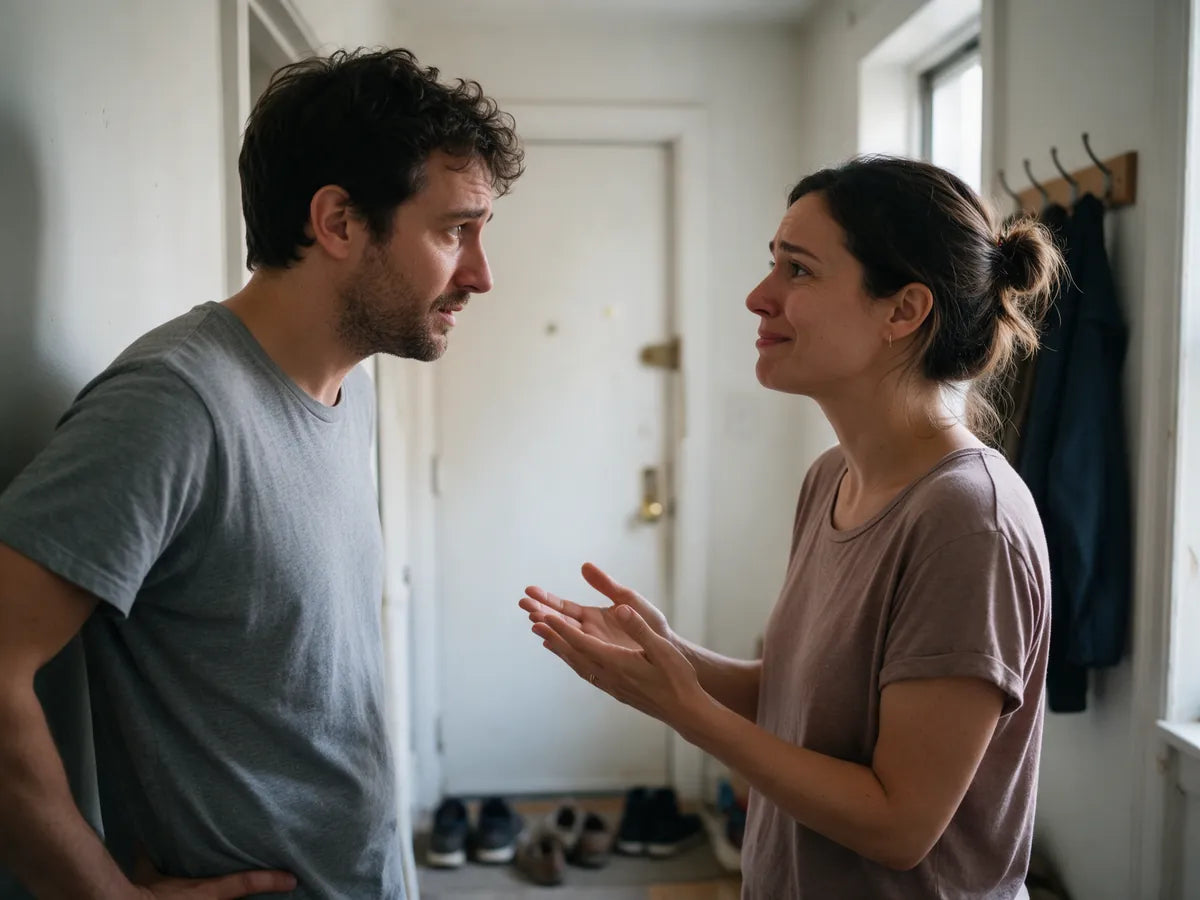
To apologize to your partner in a way that lands, name exactly what you did, acknowledge how it affected them, skip the excuses, and say what you'll do differently. Then follow through. The words open the door; the change afterward is what makes them believable.
Why some apologies make things worse
You've probably received one of these. Someone says sorry and you walk away feeling more annoyed than before. That usually happens because the apology was really about the person apologizing: their discomfort, their intentions, their need to move on.
A few patterns that tend to backfire:
- The conditional: “I'm sorry if you were upset.” This puts the problem on their reaction, not your action.
- The rebuttal: “I'm sorry, but you were also…” The second half erases the first.
- The blanket: “Sorry for everything.” Vague apologies suggest you don't know what went wrong.
- The speed-run: “Sorry. Okay, are we good?” Rushing to resolution skips the part where they feel heard.
- The self-flagellation: “I'm the worst, I ruin everything.” Now your partner has to comfort you.
The five parts of a sincere apology
- Say what you did, specifically. “I made plans for Saturday without checking with you.” Specific shows you actually understand.
- Acknowledge the impact. “That left you scrambling to rearrange your day, and it probably felt like your time didn't matter.” You're guessing, so hold it loosely, and let them correct you.
- Take responsibility without excuses. Context is allowed later if they want it. It just shouldn't be the headline.
- Say what you'll do differently. “From now on I'll check our shared calendar before saying yes to anything on a weekend.”
- Ask, don't demand. “Is there anything else about it you want me to know?” works better than “So are we okay now?”
Put together, it can be short:
“I'm sorry I made plans for Saturday without asking you. That put you in a tough spot and it wasn't fair. I'm going to check with you before I commit us to anything on weekends. Is there anything else about it that bothered you?”
Before and after: rewriting common apologies
Small wording changes make a big difference. Here are a few rewrites.
Instead of: “I'm sorry you feel like I don't listen.” Try: “I'm sorry I kept looking at my phone while you were telling me about your day. You deserved my attention.”
Instead of: “Sorry I snapped, I was just really stressed.” Try: “I'm sorry I snapped at you. I was stressed, but that's mine to handle, not yours to absorb.”
Instead of: “Okay, sorry, can we drop it?” Try: “I'm sorry. I can tell this really hurt. I'm not trying to rush past it.”
Notice that the second version in each pair is not longer by much. It's just more honest about what happened.
What about when you think you were only partly wrong?
Most fights aren't one-sided. You can still apologize for your part without accepting blame for the whole thing. The trick is to keep your apology clean and save the other topic for a separate moment.
“I'm sorry I raised my voice. That's not how I want to talk to you. I do still want to talk about how we split the weekend chores, but not right now. Can we come back to it tomorrow?”
This isn't a trade. You're not apologizing to earn an apology back. If your partner owns their side too, great. If they don't yet, your apology still counts.
When to apologize: timing matters
An apology delivered while you're still angry tends to sound clipped. One delivered a week later can feel like it took too long. Aim for the window where you're calm enough to mean it and it's still fresh enough to matter.
If the fight just ended and you need a first step before a real conversation, a short message works. Our guide on how to text your partner after a fight has examples. Save the full apology for when you're together.
What if they're not ready to accept it?
This is where a lot of apologies go sideways. You say something heartfelt, and your partner says “okay” and leaves the room. It's tempting to push: “I said I was sorry!”
Try to resist. An apology is something you give, not a transaction that obligates forgiveness. Some hurts need time to settle. You can say:
“I get it if you're not ready to talk yet. I meant what I said, and I'm here when you want to.”
Then give them room. Show up differently in the days that follow. That part does more than any perfect sentence.
Following through is the actual apology
If you promise to check the calendar and then don't, the next apology will be worth less. Pick changes that are small and specific enough that you can actually keep them. “I'll be more considerate” is hard to measure. “I'll text if I'm running more than fifteen minutes late” is easy to check.
If the same issue keeps coming up, it may be worth reading about why couples have the same argument on repeat. Sometimes the apology is fine and the underlying need just hasn't been talked about yet.
Some people find it easier to write an apology by hand first, in a notebook like a Moleskine Classic, and then say it out loud. A handwritten note left where your partner will find it can also be a gentle follow-up. Just remember that a gift or a card is not the apology itself. Flowers after “I'm sorry I forgot” can be sweet; flowers instead of “I'm sorry” usually aren't.
A note on safety
If an argument involves fear, threats, control or someone getting hurt, this advice is not the right tool. Our safety page has resources that fit that situation better.
If you can't find the words
Sometimes you know you owe an apology but can't figure out exactly what for, or you keep drafting versions that sound defensive. Before You Send can help you separate what you did from why you did it and shape an apology that sounds like you on a good day. It's a private tool for thinking, not a script to read from, and nothing gets sent without you.
An apology doesn't have to be perfect. It has to be specific, honest and followed by action. That combination is rarer than it should be, and your partner will notice.